
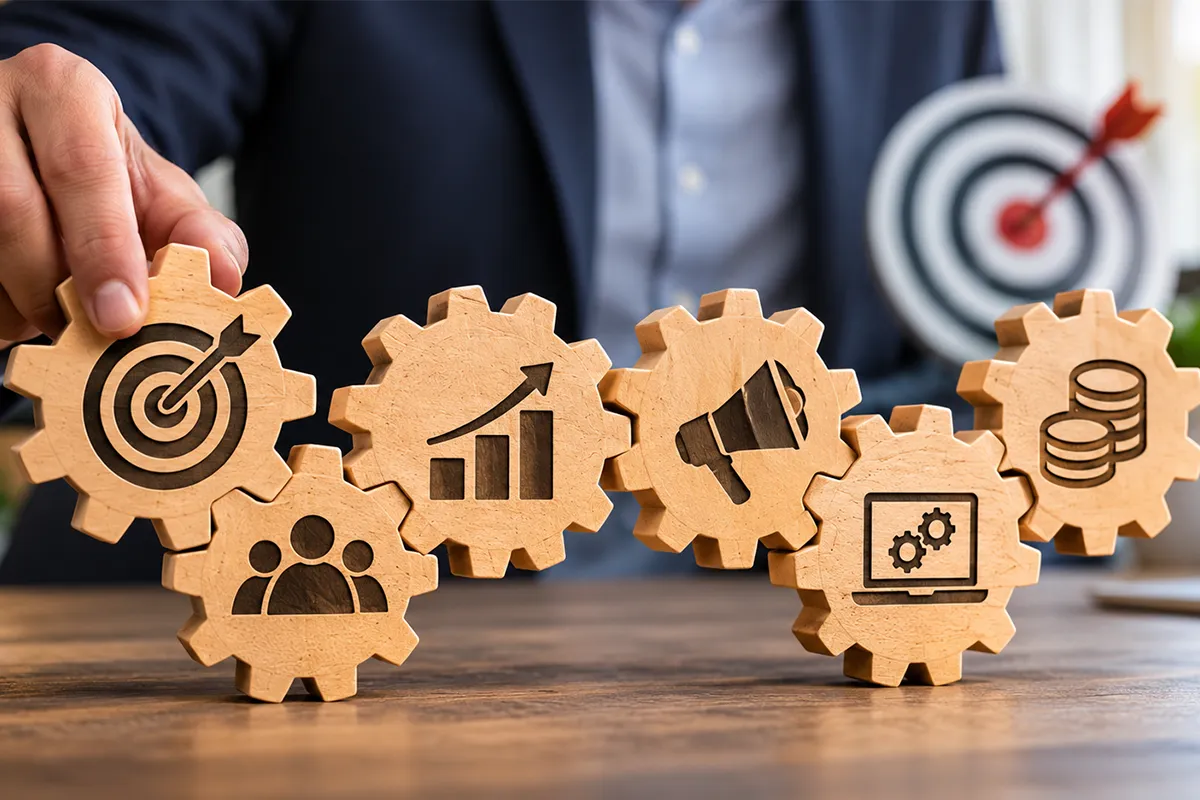
Every business has objectives. Not many have the systems in place to actually achieve them.
Ask virtually any business owner what they’re after and you’ll get the usual answers. More customers. Higher revenue. Better profitability. Better marketing. Sustainable growth.
All perfectly reasonable aspirations.
But that’s the problem. Setting a goal doesn’t in itself create the conditions under which that goal can be achieved.
You can have the most ambitious growth strategy in Scotland, the most beautifully put together business plan and a team absolutely full of spirit. Without the right systems, the right processes and the right levels of accountability in place those ambitions can very quickly turn into nothing more than a very expensive bunch of good intentions.
The businesses that keep on growing aren’t necessarily the ones with the biggest budgets, the most brilliant people or the most audacious ambitions.
They’re often the ones that have worked out how to turn strategy into repeatable, measurable action.
And that’s where systems come in.
Goals give you direction. Systems get you there.
Think about the difference between having a destination and knowing how to get there.
A business objective might be to increase revenue by 20% over the next 12 months. That’s the target.
But just how are you going to get there?
Will you generate more qualified enquiries? Will you improve your conversion rates? Will you increase your repeat business? Will you introduce new products? Will you enter new markets?
Each of those approaches requires processes, resources, responsibilities and ways of measuring progress.
That’s your system.
A goal tells you what success looks like. A system tells you what your business does every day to achieve that success. Without the latter you’re pretty much down to enthusiasm, a bit of good luck and a few heroics from the team. Not exactly a sustainable business model.
1. Understand How Your Business Actually Works
One of the most valuable things that a business owner can do is to look at how the various bits of the business work together.
Marketing creates interest. Sales turns that interest into opportunities. Operations is where the product or service is delivered. Customer support is all about maintaining the relationship. Finance is the one that keeps the whole operation commercially viable.
None of these functions exist in isolation.
Yet a lot of businesses still run as if they do.
Marketing may be generating leads that sales never properly follow up on. Sales may promise things that operations simply can’t deliver. Customer feedback may never get back to the people who are in a position to actually improve the offering.
The result is inefficiency, frustration and a complete failure to capitalise on opportunities.
This is where systems thinking comes in so useful.
Rather than looking at individual departments or activities, look at how the information, the decisions and the responsibilities flow through the business.
Ask yourself:
- Where are the opportunities being lost?
- Which processes are utterly dependent on particular individuals?
- Where are people actually duplicating work?
- What information isn’t being communicated effectively?
- What activities actually drive business growth?
You might find that improving the links between the existing activities is in fact worth more than introducing a whole new set of activities.
2. Turn Ambitious Goals Into Measurable Actions
There’s absolutely nothing wrong with wanting to grow your business.
But ‘we need more sales’ isn’t really a strategy at all.
Neither is ‘we should do more marketing’ (though that particular phrase has no doubt been behind a rather staggering number of marketing campaigns over the years).
Effective business systems start with clear, measurable objectives.
For instance rather than just trying to generate more business you might set yourself targets such as a 25% increase in qualified enquiries, an improvement in enquiry to customer conversion rate, a 15% reduction in churn, or launching a new product in six months.
These are just examples, not universal targets. The right numbers will vary from business to business, depending on the market and the business’s current performance.
Once you’ve established your objectives, work backwards.
What needs to be done? Who is responsible? What resources are required? How often do we need to check progress?
This is how business strategy becomes operational reality.
3. Build a Marketing System, Not a Collection of Marketing Activities
This is an area where I see massive potential for SMEs and growing businesses.
Lots of organisations don’t actually have a marketing system at all.
They have marketing activities.
Someone will occasionally update LinkedIn. A Google Ads campaign has been going on for years. The site gets updated when someone realises it looks a bit old. An email newsletter gets sent out when there’s something to announce.
Individually they might have some merit.
But without a clear strategy linking them then they’re not going to produce consistent, tangible results.
A good marketing system would integrate a number of key components.
Understanding your market: knowing who your ideal customer is, what problems they have and why they should choose your business.
Clear positioning and messaging: getting your value across in a way that the customer can understand and remember.
Demand generation: creating consistent opportunities to generate interest and engage prospective customers.
Lead management: making sure that leads are captured, qualified, chased and nurtured.
Measurement and improvement: working out which activities are actually delivering results and where you need to increase, decrease or redirect your investment.
The aim isn’t necessarily to do any more marketing.
It’s to make the marketing you’re already doing work harder and work more consistently.
And for businesses on a tight budget or with small in-house teams that distinction can be the difference between success and failure.
4. Remove the Bottlenecks Holding Your Business Back
As the business grows the processes which were absolutely fine with 5 people can start to become a problem with 15, 50 etc.
Info gets lost. Responsibilities get murky. Decisions take longer. There’s duplication of effort.
Sometimes the business owner becomes the biggest bottleneck as every single important decision still has to go through their desk.
Building good systems means identifying the impediments and then finding ways to get rid of them.
This could be as simple as introducing a CRM system, defining clearer project workflows, documenting the processes that get repeated time and again or automating the various admin tasks.
However there is an important distinction to be made.
Technology doesn’t automatically fix a broken process. It can sometimes just make the broken process happen faster.
Before you go and buy another software subscription, make sure you actually understand the problem you’re trying to solve.
5. Make Customer Experience Part of the System
Customer experience is invariably talked about as being all down to being friendly, helpful and responsive.
Those things obviously do.
But delivering a consistently good customer experience is far more than just having good intentions.
It requires systems that make it easier for the customer to do business with you.
Think about the journey that a customer takes from their very first point of contact with your company all the way through to them becoming a loyal, repeat customer.
How quickly are the enquiries responded to? Is the communication consistent? Are the promises kept? Do the customers get the right information at the right time? Is feedback actually collected and acted on?
A well run CRM can help bring those interactions together and give you a much clearer picture of the customer.
But the real value is in using that information intelligently.
When sales, marketing and customer service are all working in tandem you can create a much better experience, build loyalty and get people to refer you.
Existing customers are often the most neglected source of sustainable business growth.
6. Use Financial Information to Make Better Decisions
Business growth isn’t just about generating more revenue.
It’s all about generating profitable, sustainable growth.
That requires reliable financial information and regular reviews.
Good financial management systems will help a business owner to understand cash flow, operating costs, profitability and the financial impact of their decisions.
They also assist in linking marketing to commercial performance.
For instance, knowing how much you’re spending on marketing is useful.
Knowing how much it costs to acquire a customer, what that customer is worth to your business and which of your activities actually contribute to profitable growth is a lot more useful.
The aim is to move from decisions which are largely based on assumption to decisions which are based on meaningful information.
7. Make Continuous Improvement a Habit
One of the biggest mistakes that businesses make is to treat their systems as something that you build once and then you’re done with.
Markets change. The customer changes. Technology changes. The competition changes.
Your business systems need to evolve with them.
Provide regular opportunities to review performance and ask the questions of what’s working, what’s not and what could be improved.
That doesn’t mean we’re constantly reinventing the wheel.
Quite the opposite.
Often, the small improvements you make consistently deliver far more meaningful long-term results than the big changes you introduce every few years.
Encourage employees to contribute ideas, particularly those closest to the processes and customers involved. They often understand the everyday frustrations and opportunities better than anyone else.
8. Remember That People Make Systems Work
You can invest in the most sophisticated software available, document every process and produce an impressive collection of performance dashboards.
But if your people don’t understand the system, believe in its purpose or know how to use it, you’re unlikely to achieve much.
Training, communication and accountability are essential.
People need to understand not only what they’re expected to do, but why it matters and how their work contributes to the wider business objectives.
They should also feel comfortable suggesting improvements.
The best systems help people do their jobs more effectively.
They shouldn’t create unnecessary bureaucracy or turn every straightforward task into a twelve-stage approval process.
9. Use Technology and AI With a Clear Purpose
Artificial intelligence, automation and increasingly sophisticated business software offer genuine opportunities to improve productivity and decision-making.
But technology should support your business strategy, not dictate it.
Before introducing a new tool, consider whether it solves a meaningful problem, integrates with existing processes and delivers measurable value.
AI-driven analysis might help identify customer trends. Automation could reduce repetitive administrative work. Cloud-based collaboration tools might improve communication between teams.
All potentially useful. But none of them replaces the need for clear objectives, sound judgement and well-designed processes.
Start with the business problem. Then find the technology that helps solve it. Not the other way around.
So, Are Your Systems Actually Supporting Your Goals?
Here’s a useful exercise. Take one of your most important business objectives for the next twelve months.
Now ask yourself whether you have a clearly defined, repeatable process for achieving it.
Can you identify the activities that will contribute to success? Does everyone involved understand their responsibilities? Are you measuring the right things? Can you spot problems early enough to act?
If the answer to several of those questions is no, you may have identified one reason your business isn’t progressing as quickly as you’d like.
And that’s something you can address.
Better Systems. Better Marketing. Better Business Results.
Business growth rarely comes from a single brilliant idea, a clever advertising campaign or a particularly enthusiastic Monday morning meeting.
It comes from consistently doing the right things, understanding what works, and improving how your organisation operates.
Goals matter because they set direction. But systems are what turn those goals into measurable progress.
For SMEs, startups and established businesses looking to grow, developing better systems doesn’t necessarily require a major restructuring exercise or an expensive technology overhaul.
Sometimes it begins with something much simpler.
A clearer strategy. Better communication. More consistent marketing. Stronger processes. And a proper understanding of how all the moving parts fit together.
That’s where meaningful progress starts.
Need Help Turning Your Marketing Goals Into Results?
At Makin Marketing, I work with business owners, managing directors, and growing organisations across Fife, Scotland, and the wider UK to bring clarity, structure, and direction to their marketing.
With more than 25 years of experience in B2B marketing, brand development and business growth, I help businesses move beyond disconnected marketing activities and develop practical strategies, processes and systems that support their commercial objectives.
Whether you need an experienced marketing consultant, strategic marketing support, or a Fractional Marketing Director, I focus on making marketing more effective, measurable, and commercially valuable.
If your business has ambitious goals but your marketing isn’t delivering the results you expected, let’s talk and find out how I can help turn your marketing ambitions into meaningful business growth.