
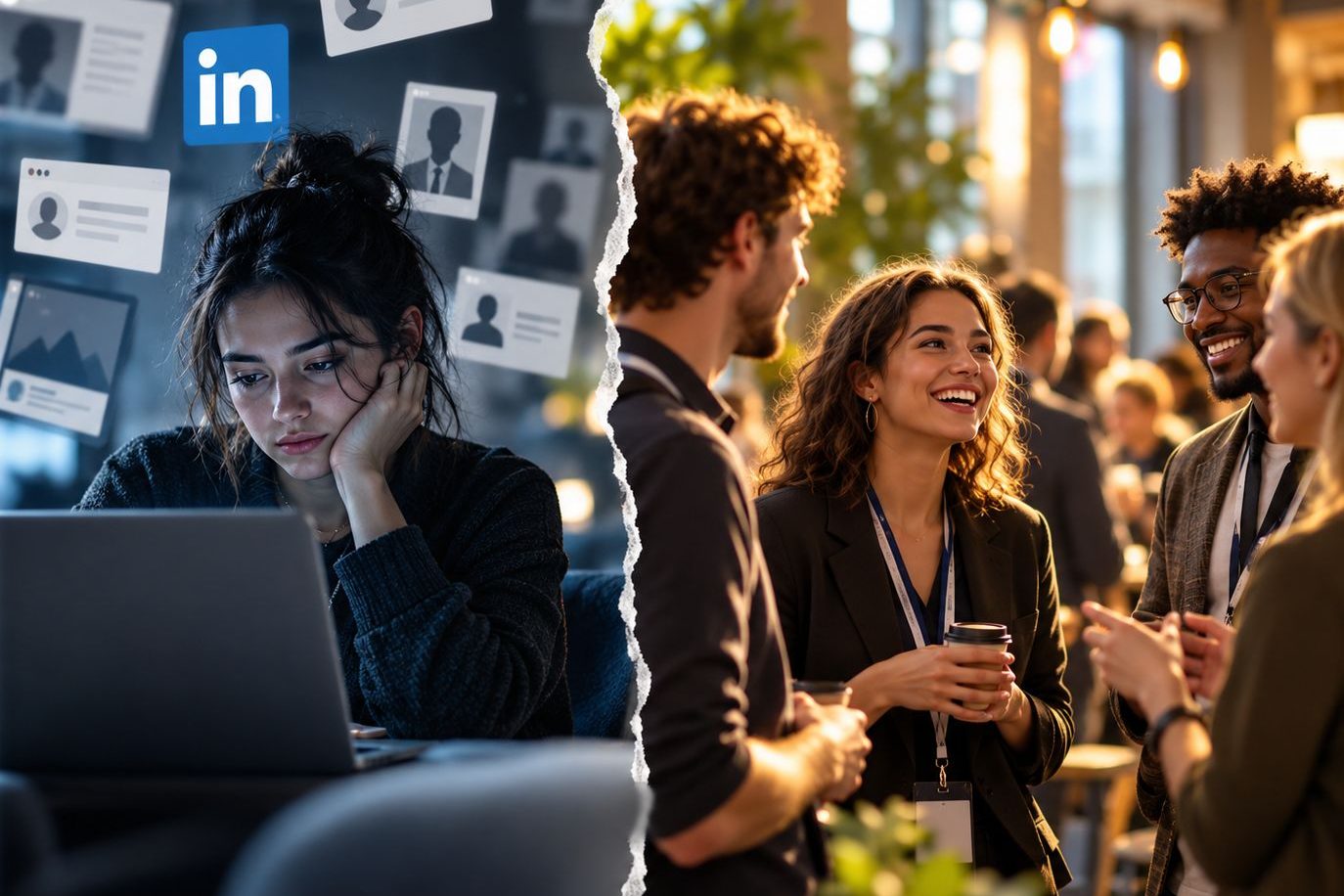
For years, businesses have been told that professional networking is becoming increasingly digital.
Build your personal brand. Grow your LinkedIn network. Post regularly. Engage with other people’s posts. Become a thought leader, ideally before breakfast.
But what if some younger professionals are quietly heading in the opposite direction?
Recently, I was on a call with the senior management team of a company I work with as a Fractional CMO when an interesting subject came up.
Their HR team had surveyed more than 300 employees around the world. Part of the research examined whether employees were championing the company and its products on social media, essentially acting as informal brand ambassadors.
One finding caught my attention.
A significant proportion of the 19-29 year olds surveyed weren’t using LinkedIn at all.
Why Are Younger Professionals Avoiding LinkedIn?
There wasn’t one single reason. Instead, several themes appeared repeatedly.
Concerns about privacy and security. Frustration with fake profiles and bad actors. Questions about the legitimacy of some job postings. Dissatisfaction with organic reach. And complaints about the experience of applying for jobs through the platform.
Interestingly, Millennials in the survey raised many of the same concerns.
The difference was that many still maintained a LinkedIn profile because they felt recruiters expected one.
But there is an important distinction here.
Having a LinkedIn profile isn’t the same as actively using LinkedIn.
Someone can have a perfectly respectable profile sitting quietly on the internet while rarely posting, commenting, networking or engaging with anyone.
LinkedIn becomes a professional directory rather than a professional community.
So Where Is the Networking Happening?
This was one company’s workforce, so I’m certainly not suggesting it represents an entire generation.
But the findings interested me because I’d suspected something similar for a while.
So, along with the HR Director, we followed up with some of the respondents and asked a fairly obvious question: If you’re not networking on LinkedIn, what are you doing instead?
The answer was surprisingly old-fashioned.
Meeting people.
In person.
At networking events, conferences, industry gatherings, meet-ups and other places involving actual human beings, actual conversations and occasionally the terrifying possibility of sustained eye contact.
After years of hearing that everything was moving online, face-to-face business networking may be becoming attractive again precisely because it isn’t digital.
Trust Still Matters
Something else emerged from those conversations.
People weren’t necessarily ignoring the internet after meeting someone.
Some would subsequently research the person or organisation online. But rather than automatically turning to LinkedIn, they often looked at the company’s own website to confirm who someone was, what they did, and whether they seemed credible.
That led to another interesting conversation with the client.
If potential employees, customers, and business contacts use your website to verify the people they meet, how good are your staff profiles?
- Are they current?
- Do they explain what people actually do?
- Do they demonstrate expertise?
- Do they look like they’ve been written by a human being rather than copied from a 2017 job description?
As a result, the company has started reviewing and updating staff profiles across its websites and online portals.
That may prove more valuable than simply encouraging another 300 employees to post on LinkedIn.
The Return of Face-to-Face Business Networking
I’ve also noticed what feels like an increase in face-to-face networking events, conferences and business gatherings.
My inbox certainly suggests they’re not going extinct. And perhaps that shouldn’t surprise us.
Digital platforms are extremely useful for maintaining connections, discovering people and sharing ideas at scale. But they’re not necessarily very good at replacing human relationships.
You can learn quite a lot from a ten-minute conversation with someone.
How they think. Whether they listen. Whether they’re interested in what you have to say. Whether they know their subject. Whether you’d trust them.
Those are difficult things to reproduce through a profile photograph, a carefully polished biography and a post beginning: “I’m delighted to announce…”
This Isn’t Really About LinkedIn
The more interesting lesson isn’t whether LinkedIn is growing or shrinking among a particular age group.
It’s about how people choose to build trust.
Businesses can easily become fixated on platforms.
- Should we be on LinkedIn?
- Should employees post more?
- Should our leadership team become thought leaders?
- Should we be making TikToks?
- Should the Finance Director have a podcast?
Possibly.
But those are channel questions.
The more important question is: Where and how does our audience actually want to interact with us?
If younger employees, customers, or potential recruits prefer conferences, networking events, communities, and face-to-face conversations, forcing them onto a particular social platform just because the marketing plan says so may solve the wrong problem.
Marketing Still Comes Back to People
I return to this regularly in my work as a Fractional CMO and marketing consultant.
Marketing technology changes.
Platforms change.
Algorithms change.
The fashionable channel changes approximately seventeen minutes after you’ve persuaded the board to invest in the previous one.
Human behaviour changes rather more slowly.
People still want to know who they’re dealing with.
They still look for signals of credibility.
They still value recommendations.
They still build relationships through conversations.
And trust remains considerably easier to establish when businesses behave like collections of human beings rather than content-distribution machines.
So perhaps the question for businesses shouldn’t simply be: “How do we get younger employees to engage with us on LinkedIn?”
Perhaps we should also be asking: “Are we creating enough opportunities for them to engage with people in the real world?”
And if they meet someone there, what will they find when they look up your business afterwards?
Because the future of professional networking might not be digital or physical.
It may be a more human combination of both.