
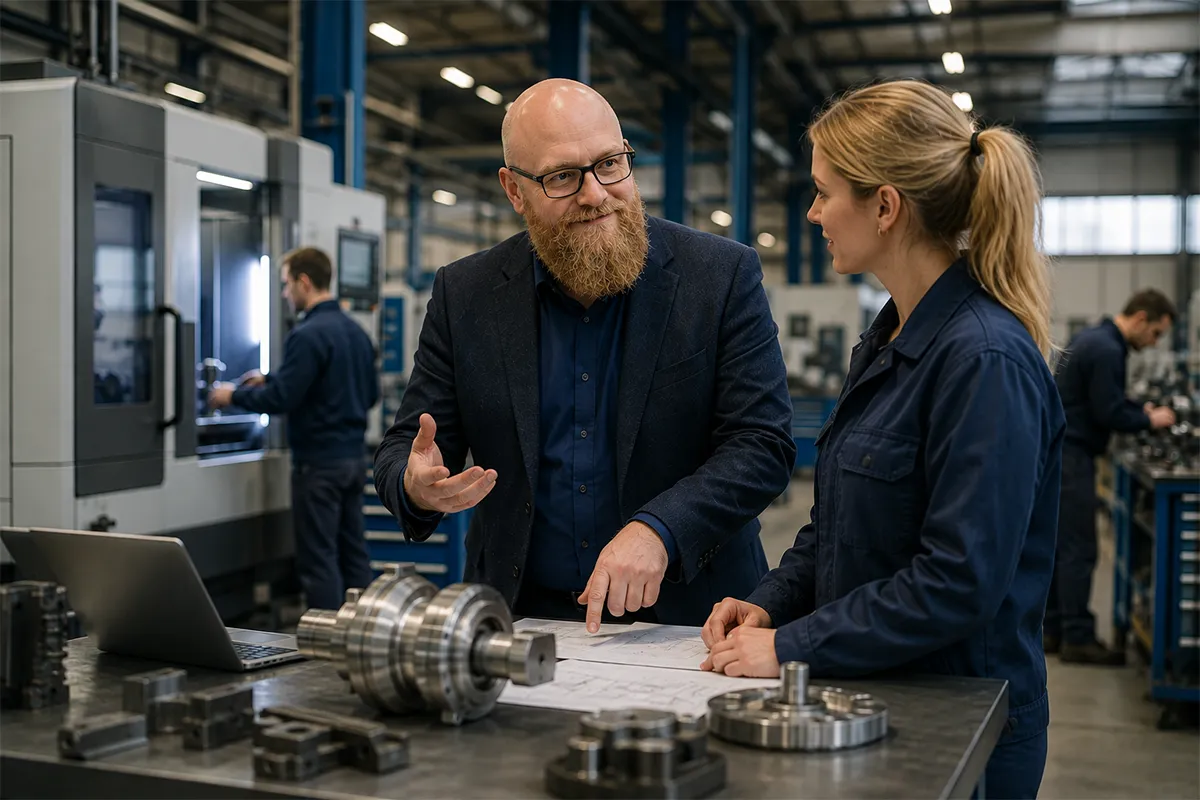
Scotland has a long history of making things.
Manufacturing is still a key part of Scotland’s economy, covering everything from precision engineering and advanced manufacturing to food and drink, electronics, energy technology, textiles, chemicals, and specialist products.
Still, many great manufacturing companies face a common marketing challenge. They are much better at making their products than explaining why someone should buy them.
Their engineering stands out, the quality is high, the team brings decades of experience, and customers keep coming back.
But their website often looks just like their competitors’ sites.
Sales presentations usually focus only on technical details.
Marketing often means an occasional LinkedIn post, a trade show, or a brochure.
A lot of growth still relies on existing relationships, referrals, and a sales director who seems to know everyone in the industry.
This approach can work quite well, but it often falls short when you want to grow.
If you want to enter new markets, attract higher-value customers, or build a stronger sales pipeline, marketing needs to be a core part of your business, not just an add-on.
Why Is Marketing Different for Manufacturing Companies?
Marketing in manufacturing isn’t about getting lots of quick, impulsive sales.
Buying decisions often involve big investments, technical reviews, procurement steps, and several decision-makers. The sales process can take months or even longer.
Customers are not just buying a part, a machine, or a product.
They are also weighing up the risks.
- Can you deliver?
- Is the product reliable?
- Do you understand their application?
- Can you meet the required standards?
- What happens when something goes wrong?
- Will you still be around in five years?
So, marketing in manufacturing needs to do its job well before a salesperson ever gets an enquiry.
Its main job is to build customer confidence.
1. Stop Marketing the Factory and Start Marketing the Value
It’s natural for manufacturing companies to focus on what they produce.
- Materials
- Processes
- Machinery
- Capacity
- Certifications
- Technical specifications
All these things can be important.
But customers mainly care about what these capabilities help them accomplish.
Your manufacturing process may reduce downtime.
Your component may last longer.
Your expertise may reduce installation time, improve safety, or lower lifetime operating costs.
You may provide greater supply-chain resilience or solve a problem competitors cannot.
This is where your marketing message should start.
Don’t just describe what you make; explain why it matters to your customers.
2. Define What Makes Your Manufacturing Business Different
One of the biggest challenges facing established manufacturers is commoditisation.
Visit ten competitors’ websites, and you may encounter variations of:
- Quality
- Innovation
- Customer service
- Experience
- Technical expertise
- Bespoke solutions
If every company says the same things, customers will usually just pick based on price.
Strong positioning identifies where your genuine competitive advantage exists.
That might be specialist expertise, faster turnaround, engineering support, product longevity, customisation, geographic coverage, technical innovation or exceptional customer service.
Whatever sets you apart should be specific, believable, and valuable to your customers.
It’s not enough to be different; you need to stand out in ways your customers actually care about.
3. Understand Who Actually Makes the Buying Decision
Industrial and manufacturing purchases frequently involve several people.
The engineer may evaluate technical performance.
Procurement considers price and contractual terms.
Operations considers reliability.
Finance looks at return on investment.
Senior management considers commercial risk.
The end user may care about something else entirely.
Effective B2B marketing in manufacturing takes these different priorities into account. Rather than using a one-size-fits-all sales message, create content that helps each stakeholder see the value you offer.
4. Turn Technical Expertise Into Marketing Content
Many Scottish manufacturers are sitting on an extraordinary marketing asset.
Knowledge.
Engineers, technicians, salespeople and customer service teams often possess decades of specialist expertise. But often, this knowledge stays in people’s heads and isn’t shared.
Turn that knowledge into useful content.
Answer common customer questions. Explain technical challenges. Compare different approaches. Discuss industry developments. Create application guides. Publish case studies. Share lessons from projects.
This is much more valuable than just having something to post on LinkedIn.It shows your expertise before a potential customer even gets in touch.
In specialist B2B markets, showing your expertise helps build trust.
5. Make Your Website Work Harder
Your website shouldn’t just be an online brochure. It should be one of your best sales tools.
A potential customer arriving through Google, an AI assistant, LinkedIn or a recommendation should quickly understand:
- What do you do?
- Who do you help?
- What problems do you solve?
- Why are you different?
- What evidence supports your claims?
- How can they take the next step?
Your product and service pages should have enough technical detail for informed buyers, but not so much that they become overwhelming.
Case studies, certifications, customer results, technical resources, and industry expertise all help lower the sense of risk for buyers.
Your website should help customers decide if you’re the right fit before you even speak to them.
6. Think Beyond Traditional SEO
Search behaviour is changing.
Potential customers still use traditional search engines, but they’re increasingly asking AI-powered platforms direct questions.
So, manufacturers should look beyond traditional SEO and also think about Answer Engine Optimisation (AEO) and Generative Engine Optimisation (GEO).
Clear, helpful content that answers real customer questions can help you get found in this new search environment.
The main idea is simple: be the best source of useful information about the problems your customers face.
7. Use Case Studies to Prove What You Can Do
Manufacturers often make big claims without enough proof. Case studies can fix that.
Instead of saying: “We provide innovative engineering solutions.”
Show what happened.
- What problem did the customer face?
- Why was it difficult?
- What did you recommend?
- What did you manufacture or deliver?
- What changed?
Where possible, quantify the outcome.
- Reduced downtime
- Lower operating costs
- Faster production
- Improved efficiency
- Reduced waste
- Longer service life
- Increased capacity
Your customers’ success stories are usually much more convincing than your own ads.
8. Don’t Treat Trade Exhibitions as Isolated Events
Trade exhibitions remain valuable for many manufacturing businesses. But just booking a stand and hoping the right people stop by isn’t really a strategy.
Start marketing before the event.
Identify priority prospects.
Arrange meetings.
Create relevant content.
Use email and LinkedIn.
Give salespeople a clear proposition.
Capture leads consistently during the exhibition.
Then follow up properly afterwards.
The exhibition itself might last three days, but the marketing opportunity can last for months after the event.
9. Align Sales and Marketing
Manufacturing businesses often have strong sales teams but relatively immature marketing functions.
This often leads to an unnecessary gap between the teams.
Sales knows what customers are asking.
Marketing needs those insights.
Marketing creates content and campaigns.
Sales needs to use them.
Both should understand which markets, sectors and customers the business wants to attract.
Marketing shouldn’t just be about generating leads. It should help sales have better conversations with the right companies.
10. Don’t Ignore Existing Customers
When growth is discussed, businesses naturally concentrate on finding new customers.
But your current customers can offer a lot of untapped value.
- Could customers buy additional products?
- Are they aware of your full capabilities?
- Could you support other sites or divisions?
- Are there opportunities for servicing, maintenance or replacement programmes?
- Would they provide testimonials or referrals?
- Could they participate in a case study?
Keeping and growing your customers should be a planned part of your marketing, not just something that happens by chance.
11. Use LinkedIn to Demonstrate Expertise, Not Just Announce Things
LinkedIn is especially useful for Scottish manufacturers in B2B markets, but your posts shouldn’t just be endless announcements like, “We’re delighted to announce…”
Show people what you know.
- Share observations from the factory floor
- Explain industry challenges
- Introduce your engineers
- Discuss innovation
- Show interesting applications
- Talk about customer problems
- Offer informed opinions
People buy from businesses, but they also buy from people. Letting your team’s expertise and personality show can make your industrial brand much more memorable.
12. Connect Marketing to Commercial Objectives
Marketing shouldn’t exist because someone decided the company ought to post more frequently on social media.
Start with the business plan.
Perhaps you want to enter the European market.
Increase exports.
Target a different industry.
Launch a new product.
Reduce reliance on one large customer.
Improve margins.
Attract distributors.
Build recurring revenue.
Recruit skilled employees.
Each objective requires a different marketing response.
Once the commercial objective is clear, you can decide which marketing activities deserve investment. Strategy determines tactics, not the other way around.
Scottish Manufacturing Has a Powerful Story to Tell
Scottish manufacturers have a powerful combination of heritage, engineering expertise, innovation and international credibility. But simply being Scottish isn’t a marketing strategy.
The opportunity is to connect that provenance with a clear commercial proposition.
For some businesses, Scottish manufacturing can communicate quality, craftsmanship and engineering heritage.
For others, innovation, sustainability or technical capability will be more important. The best approach is to make your location part of a bigger story, not the whole story.
When Does a Manufacturing Business Need a Fractional CMO?
Many established manufacturing SMEs reach a tricky stage.
They become too big for marketing to be just an occasional task shared by the Managing Director, sales team, or outside suppliers. But they’re not ready, or don’t need, to hire a full-time senior Marketing Director.
A Fractional CMO can help fill that gap.
Instead of just running marketing activities, a Fractional CMO offers senior-level marketing leadership on a flexible schedule.
That might involve clarifying positioning, developing a marketing strategy, improving brand architecture, overseeing agencies, strengthening digital visibility, aligning sales and marketing, implementing CRM systems, developing international campaigns or building an internal marketing capability.
Most importantly, marketing becomes linked to the company’s overall business direction.
How Makin Marketing Helps Scottish Manufacturing Companies
At Makin Marketing, I help business owners and managing directors make marketing a more structured, measurable, and business-focused part of their company.
My approach combines strategic marketing leadership with practical implementation.
That can include brand and market positioning, customer research, go-to-market strategy, international expansion, SEO, AEO and GEO, content and thought leadership, CRM and marketing systems, sales enablement, customer experience and marketing performance.
The goal isn’t to do more marketing just for the sake of it.
It’s about building a marketing function that supports your next business goals.
Do Scottish Manufacturers Need Bigger Marketing Budgets?
Not always. Often, they just need to make smarter choices with the budget they already have.
A business that spends £50,000 wisely can often achieve more than one that spends £150,000 across lots of disconnected agencies, ads, exhibitions, and software.
Before increasing marketing expenditure, ask:
- What are we trying to achieve?
- Who are we trying to reach?
- Why should they choose us?
- Which channels influence their decisions?
- How will we know whether it’s working?
These questions might sound simple, but getting everyone in the boardroom to agree on the answers can be much more challenging.
Key Takeaways and Next Steps
Scottish manufacturers don’t need to turn into marketing companies.
They just need marketing that clearly shows the expertise, capabilities, and value they already have.
Understand your customers.
Clarify your position.
Turn technical expertise into useful content.
Give sales better tools.
Use digital channels intelligently.
Measure what contributes to commercial growth. Most importantly, make marketing part of your business strategy, not just something you add on later.
You might make one of the best products in your industry. But if the right customers don’t know why it’s better, that’s not just a marketing issue.
It’s a growth problem.
How Strong Is Your Manufacturing Marketing?
If you’re unsure where your marketing is performing well or where it may be holding back growth, start with my free Marketing Momentum Assessment.
It takes just a few minutes and provides personalised recommendations to help identify your marketing strengths, highlight areas that may need attention and suggest practical next steps.
Alternatively, if you’re a Scottish manufacturing business looking for experienced strategic marketing leadership without employing a full-time Marketing Director, let’s have a conversation about where your business is going and what marketing needs to do to help you get there.
Email me at sean@makin-marketing.com